
 by
Marbella is the name of a town, a municipality and a brand, and the three do not cover the same ground. The municipality runs about 27 km of coastline from Cabopino in the east to the Río Guadaiza in the west, and it contains a walkable old town, a marina that functions as a small city, a golf valley, nine or ten residential districts and a working Spanish town at San Pedro. Prices across that range from €375,000 for a new one bedroom apartment to €7,800,000 for a six bedroom villa — a factor of twenty inside one municipality.

The five-minute orientation
Marbella sits on the A-7 coast road, with the AP-7 toll motorway running inland behind it. Málaga airport is about 50 km and 40 minutes by car; Estepona is 30 km west; Fuengirola 25 km east. There is no train — the Cercanías C-1 line stops at Fuengirola and goes no further west — so almost everyone here drives, and the bus network connects the main districts but slowly.
The town divides into a coastal strip, where the beaches, the promenade and most of the restaurants are, and a hillside above it, where the gated urbanisations and the large villas are. The two are five to ten minutes apart by car and a different market by price.
The districts, one by one
Marbella town and the old town
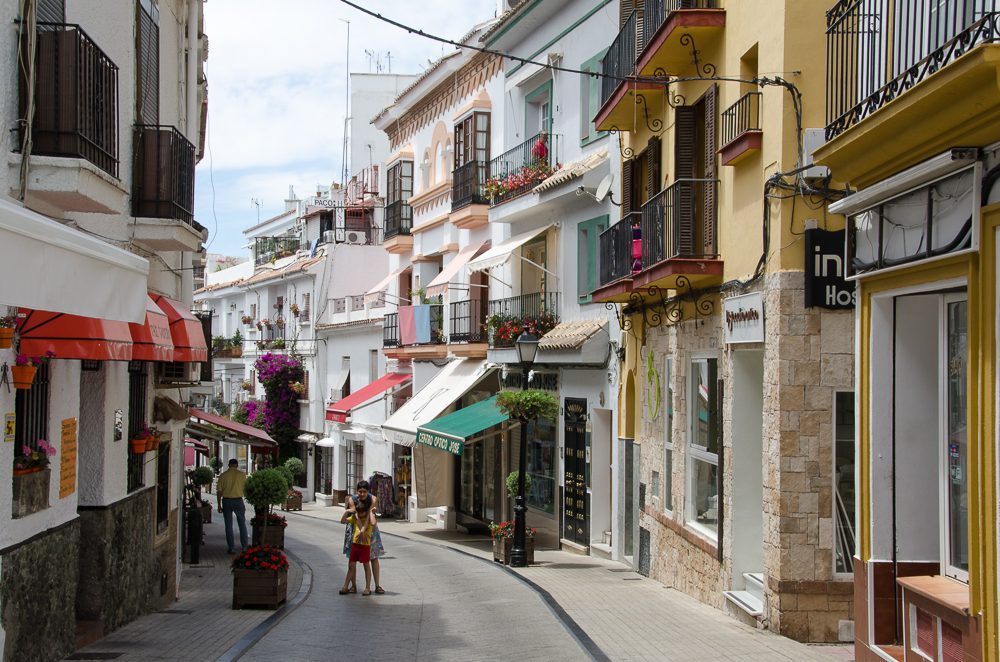
The old town around the Plaza de los Naranjos, the Avenida del Mar down to the seafront, and the streets between them. This is the only part of Marbella where you can live without a car for everyday purposes: restaurants, shops, the beach and the bus station are all within walking distance. New build here is scarce and comes as small apartment buildings rather than urbanisations. It is also the busiest address in summer.
The Golden Mile
The four kilometres between the town and Puerto Banús, containing the Marbella Club and Puente Romano. The most expensive address in the municipality per square metre, and the least available: new build is a handful of boutique schemes and individual villas. You are buying the name, the walk to the beach and the proximity to both town and port.
Sierra Blanca and Nagüeles
The hillside immediately above the Golden Mile, reached from the same exits. Gated villas on large plots, with sea views and pine woods, and the quietest of the expensive addresses. Almost no apartments. The trade-off is that you drive for everything except the view.
Nueva Andalucía
The golf valley behind Puerto Banús: Aloha, Las Brisas, Los Naranjos, La Quinta (technically Benahavís). Apartments, townhouses and villas around the courses, five minutes from the marina and ten from the town. This is where most of the new apartment supply in the municipality sits above €500,000, and the most international, year-round-populated part of Marbella.
San Pedro de Alcántara
A separate town that was absorbed into the municipality in the 20th century, with its own centre, market, health centre and a long beach promenade. More space for the money than Marbella town, a real resident population, and the most active new-build cluster at the lower end of the market. If you want walkability without the old-town price, this is the compromise.
Guadalmina Baja, Cortijo Blanco and El Paraíso
Between San Pedro and the sea, and inland towards Estepona. Golf, mature gardens, large villas, and very little apartment supply. Guadalmina Baja in particular is one of the old-money addresses of the coast.
Elviria and El Rosario
Ten minutes east of the town, in the pine woods above the beach. Family apartments and townhouses, international schools in the area, and a more residential feel than the centre. A large part of the year-round foreign resident population lives here.
Los Monteros, Altos de los Monteros, Marbesa, Artola and Cabopino
The eastern coast. Cabopino has protected dunes, a small marina and a low-rise village feel; Marbesa and Artola are beachside and quiet; Los Monteros is villa country; Altos de los Monteros is elevated with sea views and gated schemes. This is where you get space, privacy and the beach without the Golden Mile premium — at the cost of a 15-minute drive into town.
What it costs
| Developments on our books | 79 |
| Lowest starting price | €375,000 |
| Median starting price | €2,499,000 |
| Highest | €7,800,000 |
| Start under €500,000 | 8 |
| Start between €1m and €3m | 21 |
| Start above €3m | 36 |
The distribution is the point. 57 of the 79 developments start above a million, and 36 above three. Below half a million there are 8 — all small apartments on the eastern side of the town or in San Pedro. The middle of the market, €1m to €3m, is where townhouses and villas begin and where most of the choice sits.
- €375,000 — 2–4 bedrooms, 70–192 m² in Marbella.
- €409,940 — 2–3 bedrooms, 75–104 m² in La Princesa.
- €450,000 — 1–3 bedrooms, 38–56 m² in Marbella.
- €456,000 — 2–3 bedrooms, 103–154 m² in Marbella.
- €2,499,000 — 4 bedrooms, 312 m² in Marbella.
- €2,450,000 — 4 bedrooms, 218 m² in Marbella.
- €7,800,000 — 6 bedrooms, 708 m² in Marbella.
- €7,300,000 — 7 bedrooms, 720 m² in the Golden Mile.
Getting around
- Car. Effectively mandatory outside the old town and San Pedro. The A-7 is slow between San Pedro and Marbella in summer; the AP-7 toll road is the alternative.
- Bus. A local network links the town, Puerto Banús, San Pedro and the eastern urbanisations, plus intercity coaches to Málaga and Estepona. Frequency is reasonable on the main corridor, poor on the hillside.
- Airport. Málaga (AGP) is 40–50 minutes; Gibraltar about 45 minutes west. There is no train connection from Marbella to either.
- Parking. Scarce and expensive in the old town and around Puerto Banús; most new developments include a garage space, which matters more here than it sounds.
Everyday life
Marbella has a year-round population that is not purely dependent on tourism: schools, a public hospital (Costa del Sol, in Marbella), private clinics, a large shopping centre on the western edge of town, and a municipality that functions in January as well as July. The old town and San Pedro are the two places where daily errands can be done on foot. The eastern urbanisations and the hillside are car-dependent but have their own small commercial centres.
The trade-off for all of this is cost and traffic. Marbella is the most expensive place on this coast to buy, to rent, to eat and to park, and in July and August the coastal road can turn a ten-minute journey into thirty.
Who it suits — and who it does not
- It suits buyers who want an established, international town with a real centre, restaurants open in winter, and an address that carries weight on resale.
- It suits families who want to be near international schools and a resident foreign community rather than in a holiday urbanisation.
- It does not suit buyers whose priority is space per euro. At €500,000 Marbella buys a small apartment; the same money buys a townhouse in Mijas or a villa plot in Estepona.
- It does not suit anyone who wants to live without a car, unless they settle in the old town or San Pedro.
What to watch for
- Licences and planning history. Marbella spent two decades dealing with planning irregularities; the 2010 urban plan was the attempt to regularise them. Check that a property has its licence of first occupation and that nothing about the plot is in dispute.
- Community fees. Gated schemes with security, gardens and pools cost real money per month; ask for the current budget and the reserve fund.
- Rental rules. Tourist letting is regulated by the Junta de Andalucía and restricted by some communities. If the numbers depend on renting, check both before you buy.
- Summer noise and access. Visit in August if you can. A quiet lane in May is a traffic queue in July.
Frequently asked questions
Is Marbella worth the premium over Estepona or Mijas?
It depends what you are buying. For an apartment under €500,000, Estepona and Mijas give you more space and more choice. For an address above €1.5m, Marbella has supply — 57 developments above a million — that the other towns cannot match, and a resale market that supports it.
Do you need a car to live in Marbella?
Outside the old town and the centre of San Pedro, yes. There is no train, the bus network is slow on the hillside, and most districts are 5–15 minutes apart by road.
Which part of Marbella is best for families?
Elviria and El Rosario for houses near schools and the beach; Nueva Andalucía for year-round life around the golf valley; San Pedro for a Spanish town with services and a promenade. The old town is better for couples than for families with young children.
Prices in this guide come from the 79 new developments listed on this site in the municipality of Marbella in October 2026, using each development’s advertised starting price. They are supply prices, not valuations, and they change. Distances and driving times are approximate.
New developments in Marbella


The developments mentioned in this article
All 7 are live listings on this site. The price shown is the advertised starting price for the development.
- From €215,000 — 1–2 bedrooms, 48–88 m², Fuengirola.
- From €220,000 — 1–2 bedrooms, 52–79 m², Fuengirola.
- From €282,450 — 1–3 bedrooms, 66–287 m², Fuengirola.
- From €705,000 — 2–3 bedrooms, 83–130 m², Fuengirola.
- From €699,900 — 2–3 bedrooms, 105–160 m², Fuengirola.
- From €3,960,000 — 4 bedrooms, 280–400 m², Fuengirola.
- From €2,695,000 — 3 bedrooms, 265 m², Torreblanca.
Related reading
- New developments in Marbella 2026 — the whole market, band by band.
- All buying guides — prices, costs, checks and area guides.
- Off-plan in Marbella: seven checks — before you pay a deposit.
- Living in Estepona — the neighbouring municipality.


Join The Discussion